Webinar follow-up report
The webinar “How industry can drive change in closing the whole-grain gap” made a strong case for why whole grains should be a strategic priority for the commercial sector. The speakers highlighted the combined health, sustainability, consumer, policy, and business arguments for accelerating the shift from refined grains to whole-grain products.
The session was driven by the ICC Whole Grain Initiative, organized and hosted by EUFIC and ICC, with the clear aim of inspiring industry stakeholders to take a more active role in increasing whole-grain usage and consumption. The speakers positioned whole grains not only as a nutrition issue, but as a systems topic with relevance for public health, environmental sustainability, and commercial innovation.
Main messages
Christophe Courtin, Professor at the University of Leuven in Belgium, where he leads a research group focused on cereals, whole grains, and health, emphasized that replacing refined flour with whole-grain flour retains valuable bran and germ fractions, which improves nutritional quality and reduces environmental impact. He also referenced evidence linking higher whole-grain intake with better health outcomes, including lower risks of type 2 diabetes, coronary heart disease, colorectal cancer, and overall mortality. The presentation also stressed that current whole-grain intake remains far below recommended levels in Europe and globally.
Mikkel Andersen, industry representative from Lantmännen Unibake in Copenhagen, Denmark, underlined that the market opportunity is real: consumers increasingly associate whole grains with health, and many also perceive them as tasty and suitable for everyday products such as bread, cereals, pasta, and rice. At the same time, they noted that price, availability, and habit remain the biggest barriers to change.
Policy and institutional momentum
Caroline Sluyter, Senior Director of Operations at Oldways in Boston, USA presented examples showing that whole grains are gaining ground in policy and institutional settings. She highlighted growing alignment in dietary guidelines, stronger focus on labeling, public procurement, and public-private partnerships, as well as examples from Denmark and Sweden where coordinated action has helped increase whole-grain intake. The message was that the policy environment is increasingly supportive, and industry can now move faster in response.
Industry role and examples
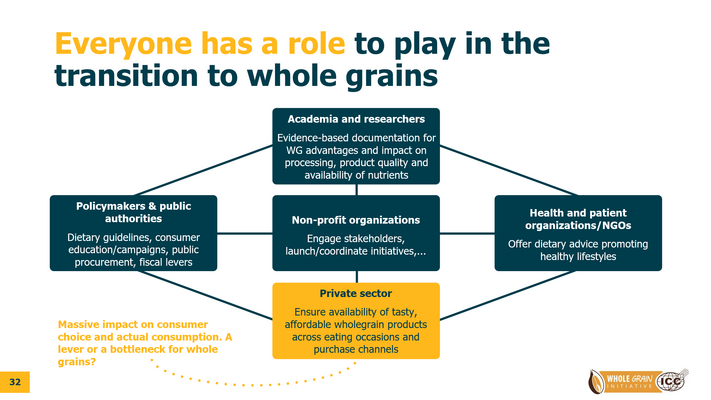
A key theme of the webinar was that the private sector sits closest to consumers and therefore has the strongest ability to influence everyday dietary choices. The speakers outlined several levers for action, including reformulation, affordability, shelf placement, promotions, clear labeling, and taste-led marketing. They also shared examples of companies and retailers already making progress, such as Cereal Partners Worldwide, PepsiCo, Lidl, Walmart, Albert Heijn, Kelenova, Podravka, Lantmannen, and Brüggen.
Key outcomes and resources
The webinar closed with a practical call to action: join the ICC Whole Grain Initiative working groups, subscribe to updates, follow the initiative’s channels, and engage with International Whole Grain Day in November. Ece Göncü, Head of Nutrition, Regulatory and Scientific Affairs at Cereal Partners Worldwide and also President of CEREAAL, the European Breakfast Cereals Association, presented sector toolkits developed to support reformulation in breakfast cereals and baked goods, and noted the recent announcement of an ISO standard for whole grain as a major milestone for definitions, regulation, and future claims.
Overall, the webinar reinforced that closing the whole-grain gap will require coordinated action across science, policy, and industry, with the private sector playing a decisive role in turning evidence into accessible, affordable, and appealing products for consumers.